How to Brief Cases - A 90 Minute Guide
How to Brief Cases is taken from the How Succeed in Law School in 5 Hard Steps. In 90 minutes, you'll learn how to brief cases correctly, and quickly using our proven method.
1.01 - Introduction to Briefing Cases (48s)
1.02 – What is a Case? (6m, 43s)
1.03 – Knowledge Check
1.04 – Briefing: What is it and why do it? (7m 22s)
1.05 – Knowledge Check
3.06 – The Elements of a Brief Pt. 1: Style & Action
3.07 – Knowledge Check
3.08 – The Elements of a Brief Pt. 2: Facts, Posture & Holding
3.09 – Knowledge Check
3.10 – The Elements of a Brief Pt. 3: Rule & Notes
3.11 – The Right Way to Read a Case
3.12 – Knowledge Check
3.13 – Exercise: Brief 3 Cases
3.14 – Hamer v. Sidway brief
3.15 – Knowledge Check
3.16 – Vosburg v. Putney
3.17 – Knowledge Check
3.18 – Pierson v. Post
3.19 – Knowledge Check
3.20 – Conclusions on Briefing
3.21 – Conclusions


How to Succeed in Law School in 5 Hard Steps is an online law school prep course produced by noted legal educator Professor James E. Byrne. This program covers fundamental practices that all first year law students must master in order to attain A level grades throughout their law school career. By helping to establish proper study techniques, encouraging you to rid yourself of unhelpful habits, and helping you master critical drafting skills, the How to Succeed in Law School program will set you up to not only ace your law school exams, but succeed.
Why Our Program:
Most 1Ls are unprepared for the challenges of the first year. Attitudes and methodologies carried over from college, however successful they may have been, leave students ill- prepared for law school.
This program is designed to give first year law students a realistic viewpoint of how to approach legal education, and the tools necessary to get A's on exams. This program is intended to shift your attitude and perspective, and to help you avoid the pitfalls faced by most students in the first semester.
One of the most common mistakes made by 1Ls is spending too much time preparing for class, and not enough time outlining or preparing for exams. The final exam is the end towards which all of your work during the semester is a means. To that effect, proper time management, efficient briefing and outlining are essential components in achieving A’s on exams. In the How to Succeed Program, you will learn how much time should ideally be spent briefing, outlining, and preparing for exams, and how each of these critical processes can be undertaken most effectively.
Who is this for:
This program is designed to be helpful to all first year law students. In fact, the tools you will learn are applicable for all of law school, and even for much of lawyering!
Second semester students who didn’t perform as well as they’d hoped stand to benefit greatly from the How to Succeed program. By establishing proper study techniques, and ridding yourself of unhelpful habits and perceptions accrued during the grind of the first semester, you will enable yourself to drastically improve your performance for the rest of law school.
New students in their first semester will be given a monumental advantage over the competition by beginning this program right away. You will learn to avoid the all-too-common stumbling blocks and misuses of time that plague 1Ls and develop strong habits from the start.
1. Perspective
2. Time Management & Class Preparation
3. Briefing & Strategies for Non-Casebook Courses
4. Outlining & Pre-Exam Preparation
5. Exam Preparation
Step 1
It is critical that you learn the right perspective with which to view your law school career. The first semester of law school is likely the most difficult, and often plays an outsized role in your legal career, affecting your class rank and potential summer and post-graduate employment opportunities. You must possess the correct mindset in order to be prepared for what lies ahead.
Step One Covers: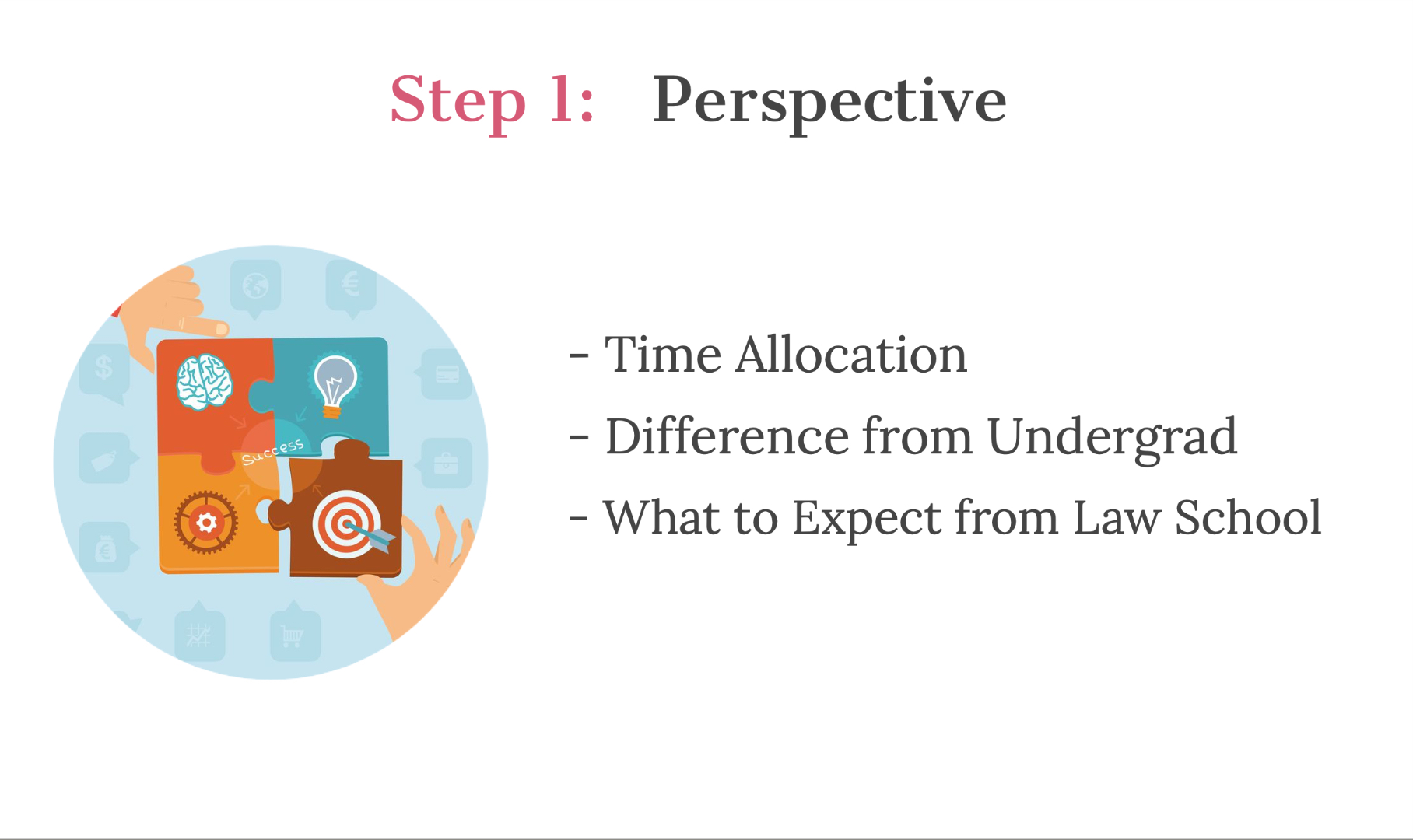
- The Necessary Mindset for Law School
- Learning to Operate in a New and Challenging Structure
- Starting Strong for your Legal Career
Step 2
Just how much time should you spend briefing and outlining? How important is legal writing in your first year of law school? Step 2 answers these questions, and walks you through the necessary process of building a law school schedule - including everything down to sleep and exercise. You may just be surprised with what Professor Byrne suggests prioritizing as a 1L.
Step Two Covers: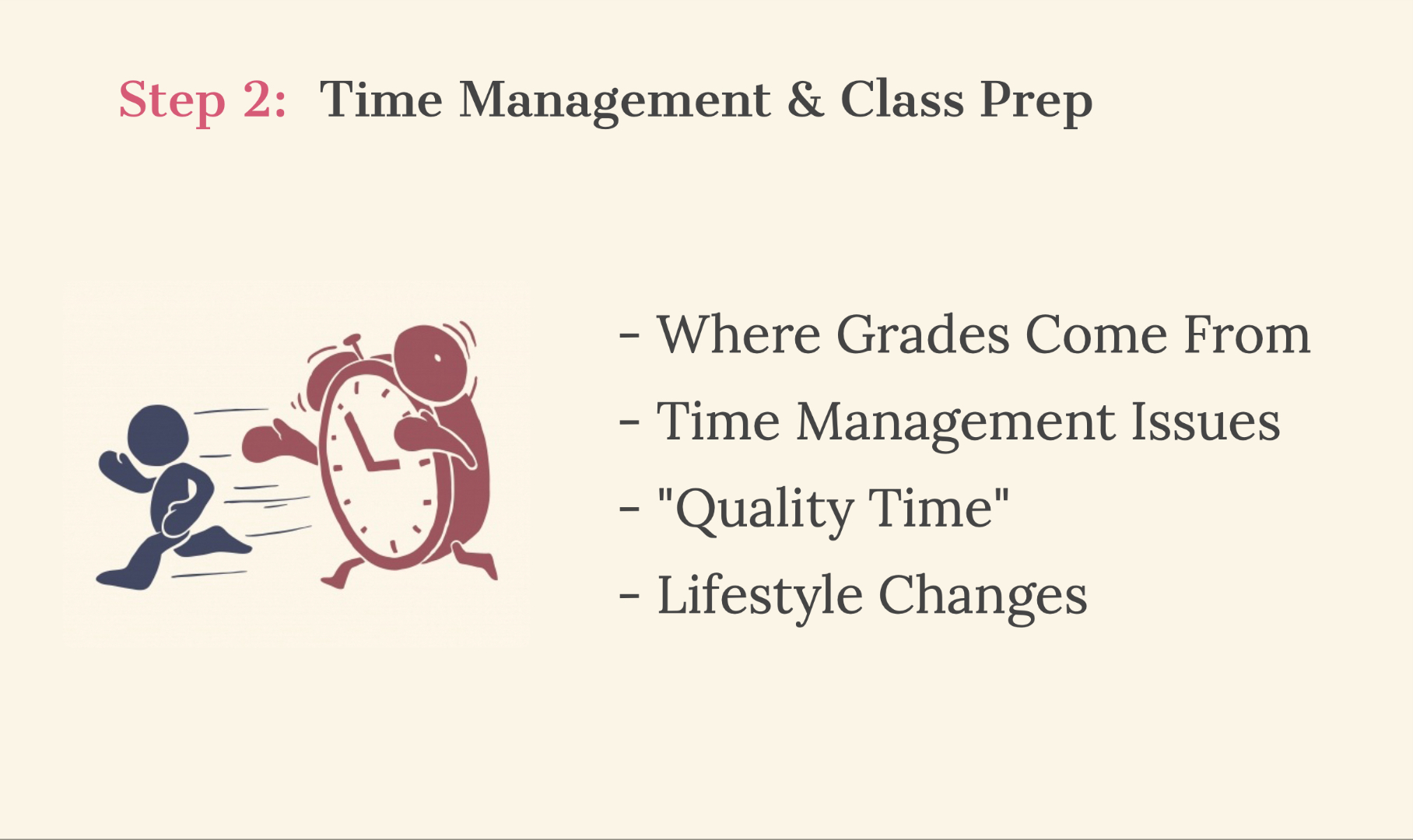
- How to Prioritize and Manage Your Time
- Efficient Class Preparation Tools
- The How & Why of Building a Schedule
Step 3
"Briefing is a skill which takes a lot of work, and quite a lot of practice. If a student spends the first year working from canned briefs, he or she is going to be at a disadvantage in their first summer position, their clerking position, etc., because they will not have had the opportunity to learn the skills necessary to read quickly, to summarize, to understand and capsulize the contents of a brief, and to be able to assess what a case stands for."
- Professor James E. Byrne
In Step 3, you will learn how to properly brief cases so that they serve as the core of your Exam Outlines. This means learning the elements of a case, what each element means for your understanding, and then how to turn those elements into a case brief. You will then brief three cases, and compare them to the sample briefs prepared by Professor Byrne.
Step Three Covers: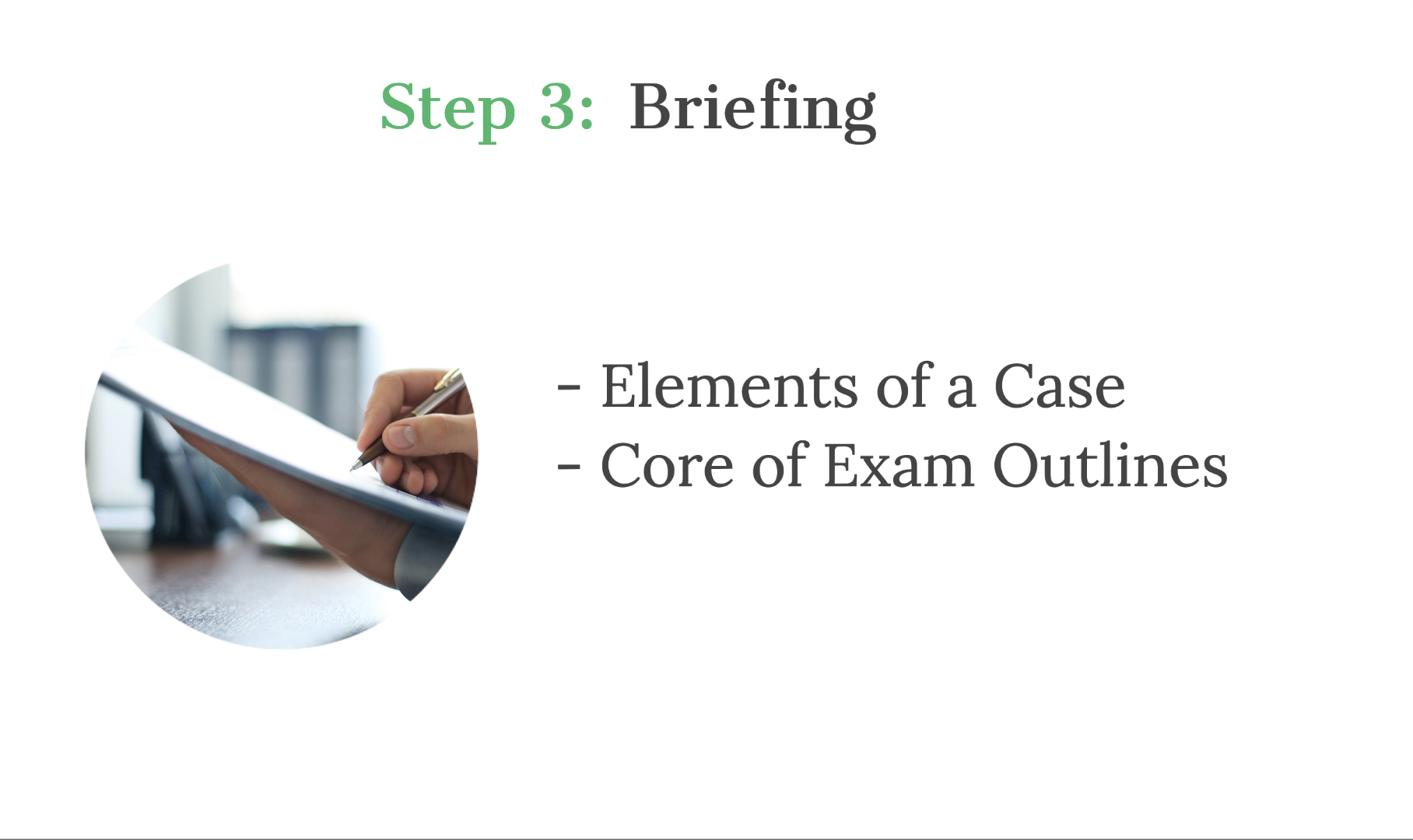
- The Optimal Approach to Briefing
- How to Effectively Read a Case
- What to Do with a Brief in Class
- The Briefing Method Illustrated
Step 4
"What constitutes outlining may seem obvious but most law students do not fully appreciate the concept, and some students misunderstand it altogether. Outlining is not a thing but rather a process. It is the process of internalizing information, ideas, and concepts to the end that the product is not so much its manifestation on paper or a computer file as it is the interior grasp, or intimate appreciation of the concepts and process that it represents. Interiorizing a law school subject is the process of understanding the context in which the area of law arises in real life, identifying the problems that the law addresses, having such a command of first principles that they form part of the student’s analytical architecture, and being able to apply these. In another sense, outlining is a search for patterns, principles, and the evolution of doctrine or law." - Professor James E. Byrne
In Step 4, you will learn how your classwork, briefs, the “legal treatises”, and your professor’s tendencies ensure your Exam Outlines evolve from a series of statements into prose, designed to give you a formula to systematically answer exam essay questions quickly and concisely.
Step Four Covers:
- What Outlining is/isn’t
- The Role of an Outline
- The Steps to Successful Outlining
- Practical Breakdown of Outlining Steps
- Pre Exam Preparation guide
Step 5
"Because first year law students have taken tests during their entire educational career, they may think that there is no need for advice or assistance in taking law school tests. We want to set the record straight: law school examinations are radically different from college examinations. "
- Professor James E. Byrne
Step 5 will bring all of this preliminary work from the prior four steps to bear in the final weeks before your exam. The intense work and training thus far has all led to this point, or more precisely, to the final exam.
Step Five Covers:
- How to Tie Together the Work from Steps 1-5 with a View Towards Exams
- How to Deal with Each Type of Exam
- How to Optimize Your Exam Preparation
- How Best to Sit an Exam